

Understanding Bearings: Fundamentals & Applications
01What are bearings?
Bearings are mechanical components used to reduce friction between moving parts. They allow rotating or moving elements to operate smoothly and efficiently. Almost every application involving rotation or relative motion requires some form of bearing.
02Types of bearings
The primary function of bearings is to reduce friction. Friction can generally be divided into three interface or contact types: rolling, sliding, and air. Different contact methods during rotation lead to different bearing designs, precision levels, and application scenarios. Based on operating principles, bearings can be broadly classified into three main categories:
Rolling Bearings
Rolling bearings are the most common type. They consist of an inner ring (cone), an outer ring (cone), and rolling elements such as steel balls or rollers. This design converts sliding friction into rolling friction, typically through point or line contact, which significantly reduces wear and rolling resistance. Rolling bearings are widely used in high‑speed and high‑efficiency applications.
Plain Bearings
Plain bearings do not contain rolling elements such as balls or rollers. Instead, they rely on a thin lubricating oil film within a confined space to reduce friction during operation. They have a simple structure and are capable of supporting high loads. However, continuous lubrication is essential to maintain the oil film and prevent direct contact and wear.
Air Bearings
Air bearings use a thin film of pressurized air between two surfaces (for example, a shaft and a bearing) to eliminate direct contact during motion. As a result, there is almost no wear during operation. Air bearings offer extremely low friction, minimal noise, and no contamination. However, they require very high manufacturing precision, accurate alignment, and strict environmental control. They are commonly used in semiconductor manufacturing, precision machinery, and cleanroom applications.
03 How Do You Choose Bearing?
Depending on the application, bearings may mainly experience axial loads, radial loads, or a combination of both. It is important to identify which load type is dominant and to calculate the proportion of axial and radial forces accurately.
Higher rotational speeds generate more heat. Increased heat accelerates wear and causes lubricants to degrade more quickly, which can shorten bearing life if not properly managed.
Bearing selection should be based on the magnitude of the applied loads as well as the weight and operating conditions of the product itself.
Some applications operate in harsh environments such as high temperatures, underwater conditions, high dust levels, or high vibration. In such cases, special attention must be given to bearing sealing design and material selection, such as stainless-steel bearings or ceramic rolling elements.
Installation constraints, such as mating part tolerances and available space, play a critical role in determining suitable bearing size and type.
Bearings are manufactured with different internal clearance classes between the inner ring, outer ring, and rolling elements. Clearance that is too small may cause excessive heat generation, while clearance that is too large can result in vibration or misalignment. Additionally, heat generated during operation can cause thermal expansion, further reducing internal clearance.
TH Industry’s engineering team can calculate applied loads and bearing life to help you select the most suitable bearing type and specifications for your application.
What Is a Bicycle Headset Bearing?
How Do You Choose a Headset Bearing?
A Complete Analysis of Angular Contact Bearings (ACB), Contact Angle, and Solid Bearings
This article organizes common questions about bicycle headset bearings in a Q&A format, including which type of bearing is most suitable for a headset, why angular contact bearings (ACB) are commonly used in headset assemblies, how contact angle affects bearing load, what kinds of waterproof structures are available, and the durability and design considerations of solid bearings in fully integrated cable routing frames.

Headset Bearing Key Highlights
1. What type of bearing is best suited for bicycle headsets?
Angular Contact Bearings (ACB) are the optimal bearing type for bicycle headsets.
2. Why are Angular Contact Bearings preferred for headsets?
Headsets are subjected to complex, multi‑directional loads during riding. There are 3 load factors to consider:
- Axial loads from road input: Vibration and impacts transfer vertically from the tire through the wheel, fork, and into the headset.
- Axial loads from rider weight: Rider weight applied through the handlebar and stem places continuous axial load on the headset bearings.
- Radial loads during steering: Steering input generates radial forces as the handlebar and fork rotate.
Because these axial and radial forces act simultaneously and in combination – often at high magnitude during sprinting, climbing, or aggressive riding – the headset bearings must manage combined loads. Angular Contact Bearings are specifically designed to handle combined axial and radial loads efficiently, making them ideally suited for headset applications.
3. What is a bearing contact angle?
As seen in the image below, the contact angle is defined as the angle between:
- The line connecting the two contact points between the ball and the inner (B) and outer (A) raceways
- And the axis of rotation of the bearing
This angle determines how loads are distributed within the bearing.
4. Are different contact angles available, and why do they matter?
Yes. Contact angles range between 0° and 90°, depending on the application and required load balance:
- 0° contact angle: Designed primarily for radial loads; commonly used in bicycle hub cartridge bearings.
- Higher contact angles: Increase axial load capacity while maintaining radial load support.
- 90° contact angle: Characteristic of thrust bearings, which are designed for axial loads only (common in motorcycles or industrial applications).
For bicycle headsets, a higher contact angle is essential to effectively manage combined axial and radial forces generated during riding.
5. What waterproofing solutions are used in Angular Contact Bearings?
ACB headset bearings typically use one or a combination of the following sealing concepts:
- Labyrinth sealing
- Uses precisely shaped inner and outer race profiles combined with O‑rings
- Provides excellent water and contamination resistance
- Trade‑offs include higher friction and increased manufacturing cost
- Contact seal design
- Light contact between raceways and dust covers
- Lower friction and cost
- Reduced sealing effectiveness under severe conditions
- Hybrid sealing (most common)
- Combines elements of labyrinth and contact designs
- Balances sealing effectiveness, durability, friction, and cost
- Widely used in premium headset bearings
6. With increasing full cable integration, bearing lifespan is critical. Do modern premium bicycles use ACB headsets?
Yes. The majority of premium bicycles, especially those with fully integrated cable routing, use Angular Contact Bearings due to their superior load handling, durability, and alignment tolerance.
7. How does TH address durability and sealing challenges in integrated headsets?
TH utilizes solid lubrication technology in its headset bearings to significantly enhance durability and environmental resistance.
Unlike conventional grease‑ or oil‑based lubrication, solid lubrication:
- Resists water ingress and washout
- Offers excellent corrosion resistance
- Maintains consistent lubrication over long service intervals
- Performs reliably in extreme riding conditions
TH refers to this technology as HPB (High Performance Bearings).
8. How common is solid‑lubrication bearing technology in the headset market?
TH is the only brand offering this technology in a true solid‑lubricated Angular Contact Bearing configuration for bicycle headsets.
9. Do similar systems from other brands qualify as solid‑lubricated bearings?
Some competing solutions incorporate polymer elements; however, these do not meet the definition of a true solid‑lubrication bearing.
In those designs:
- The polymer is formed prior to ball installation
- Larger internal clearances are required
- Additional dust covers are typically necessary to achieve acceptable sealing performance due to clearances
10. Why is TH HPB considered true solid‑lubrication bearing technology?
TH HPB bearings are engineered with:
- Solid lubricant integrated directly with the bearing balls
- A seamless internal structure that eliminates the need for additional dust covers
- Full ball complement for improved load distribution
- Self‑lubricating and self‑sealing performance that significantly extends bearing service life
This integrated approach delivers superior waterproofing, durability, and long‑term performance.
11. How does TH prevent cable abrasion in fully integrated headsets?
During development, TH:
- Eliminates sharp edges and stress points that could damage hoses and cable housing
- Designs bearing interfaces and routing paths with cable movement in mind
- Uses proprietary test equipment to simulate high‑cycle, real‑world steering and rotation scenarios
This ensures durability and protection of internally routed cables over the product’s lifespan.
12. Why is TH a preferred bearing supplier for many bicycle brands?
TH is recognized for its advanced R&D capabilities and system‑level engineering approach. This includes:
- Finite element analysis and real‑world load simulation
- Validation of axial, radial, and combined forces
- Consideration of complete system interaction rather than individual components
This comprehensive approach enables reliable, high‑performance bearing solutions tailored to modern bicycle design requirements.
TH HPB Solid Lubrication Bearing Comparison
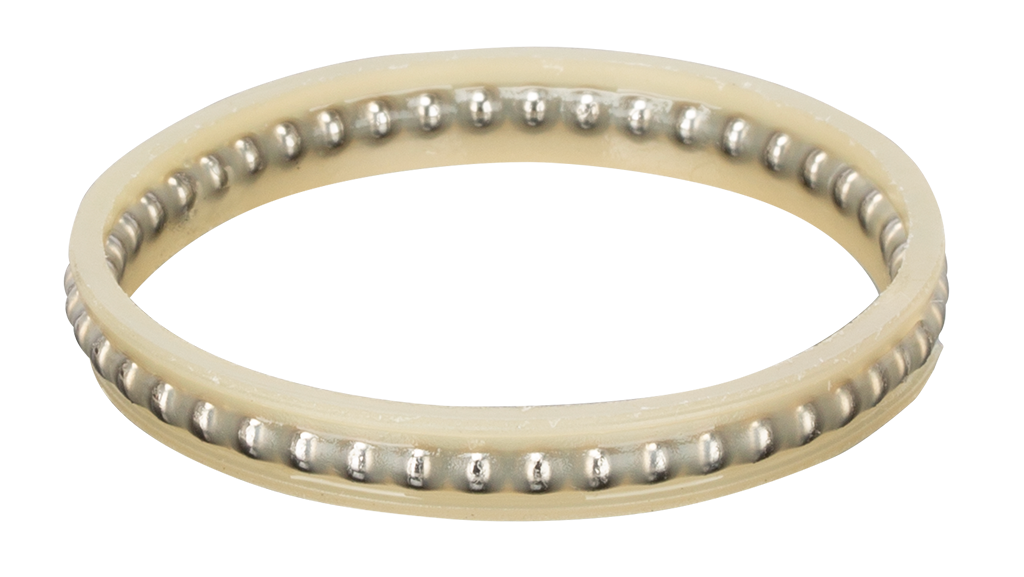
The polymer and bearing balls are molded together as a single structure. The polymer contains millions of microscopic pores that effectively absorb and retain lubricant. During rotation, the polymer releases oil in a stable and consistent manner, ensuring uniform lubrication.
Lubricant Release: During riding, rotational friction generates mild heat. Oil is gently pushed from the pores to the surface, forming a consistent oil film. Lubricant Reabsorption: When the bearing cools, the remaining lubricant is drawn back into the pores through capillary action.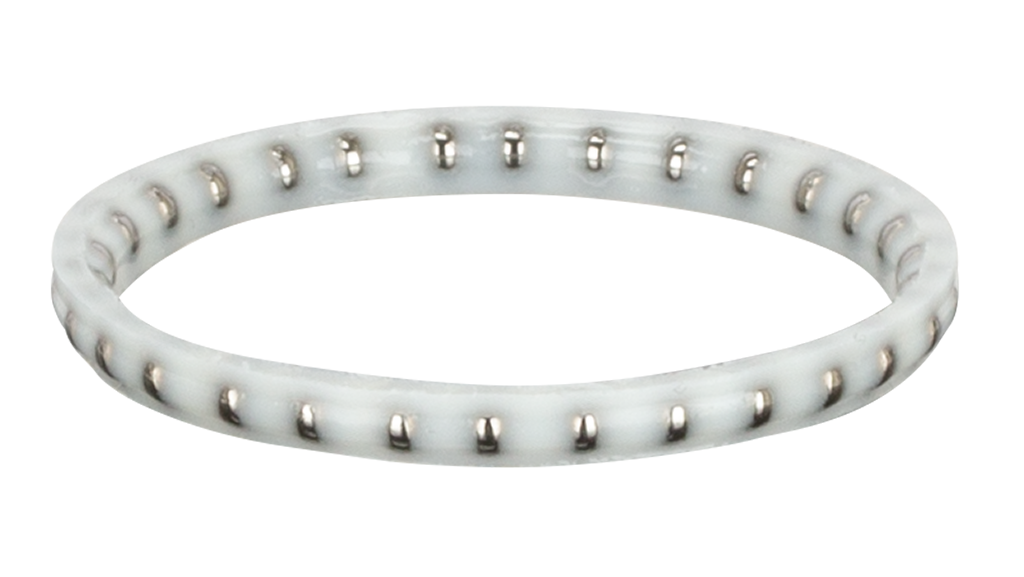
Caged bearings use steel balls and polymer that are molded separately and then assembled. Due to weaker contact between the polymer and the bearing rings, negative pressure can occur, increasing the risk of moisture penetration.
The polymer fully fills the inner and outer cone areas, leaving no space for dust or moisture to accumulate. This “fully filled” engineering design forms an extremely strong protective barrier and requires precise molding and injection-processing capabilities.
Large empty gaps remain in the inner and outer cones, making the design susceptible to negative pressure effects. To compensate, two additional seals are typically required. However, this remains a conventional bearing structure with limited durability.
HPB bearings incorporate a radius on the inner-ring corner. This detail, though small, demonstrates engineering precision and prevents long-term abrasion damage to internal cable-routing components.
The common solutions inner-ring corners typically lack radius treatment. Over time, sharp edges can cut into cable-housing protection layers or related components, eventually causing failures.
Durability Test Comparison
Additional Point: Negative Pressure Effect
Negative pressure happens when there is a difference between the pressure inside and outside of the bearing. Just like how air moves in and out of the human body when we breathe, a strong pressure difference can pull in dust, moisture, and other contaminants. When this occurs, dirt and water vapor can enter the bearing and affect its performance.